wearable assistive device · BME:3710

A passive tuned mass damper for hand tremor

A forearm-worn damper that fights tremor with physics rather than electronics: two sprung masses tuned to oscillate out of phase with the shake. Taken solo from biomechanical model through MATLAB simulation, Creo assembly, and a wearable prototype.

Deliverables

This was a solo midterm with six required deliverables. Kian was the only contributor to the design and the prototype build.

#DeliverableWhat it produced
IMathematical model and biomechanicsFree-body model of the lower arm with bicep and tricep as tremor drivers, and the coupled arm–damper equations of motion
IISolid model and virtual prototypeCreo assembly of the sprung-mass boxes, center support, arms, and lead masses
IIIDesign specificationsBox, spring, and arm dimensions sized from anthropometric tables against a 77 in frame
IVLow-fidelity prototypeTwo wearable sleeves, left and right, at 50 g and 25 g box weights
VStandard operating procedureBill of materials, ten-step build, wear instructions, and failure warnings
VIPresentationFourteen-slide defense of the model, simulation, and build

The MATLAB dynamic model and the background research sat alongside these as supporting work. All three source documents are downloadable at the bottom of this page.
Modeling the arm

The device is meant to be worn whenever tremor gets in the way of something that needs a steady hand, which in practice means cooking, writing, shaking hands, holding someone. That framing set the constraint: it has to be light, self-applied, and worn in public without drawing attention.

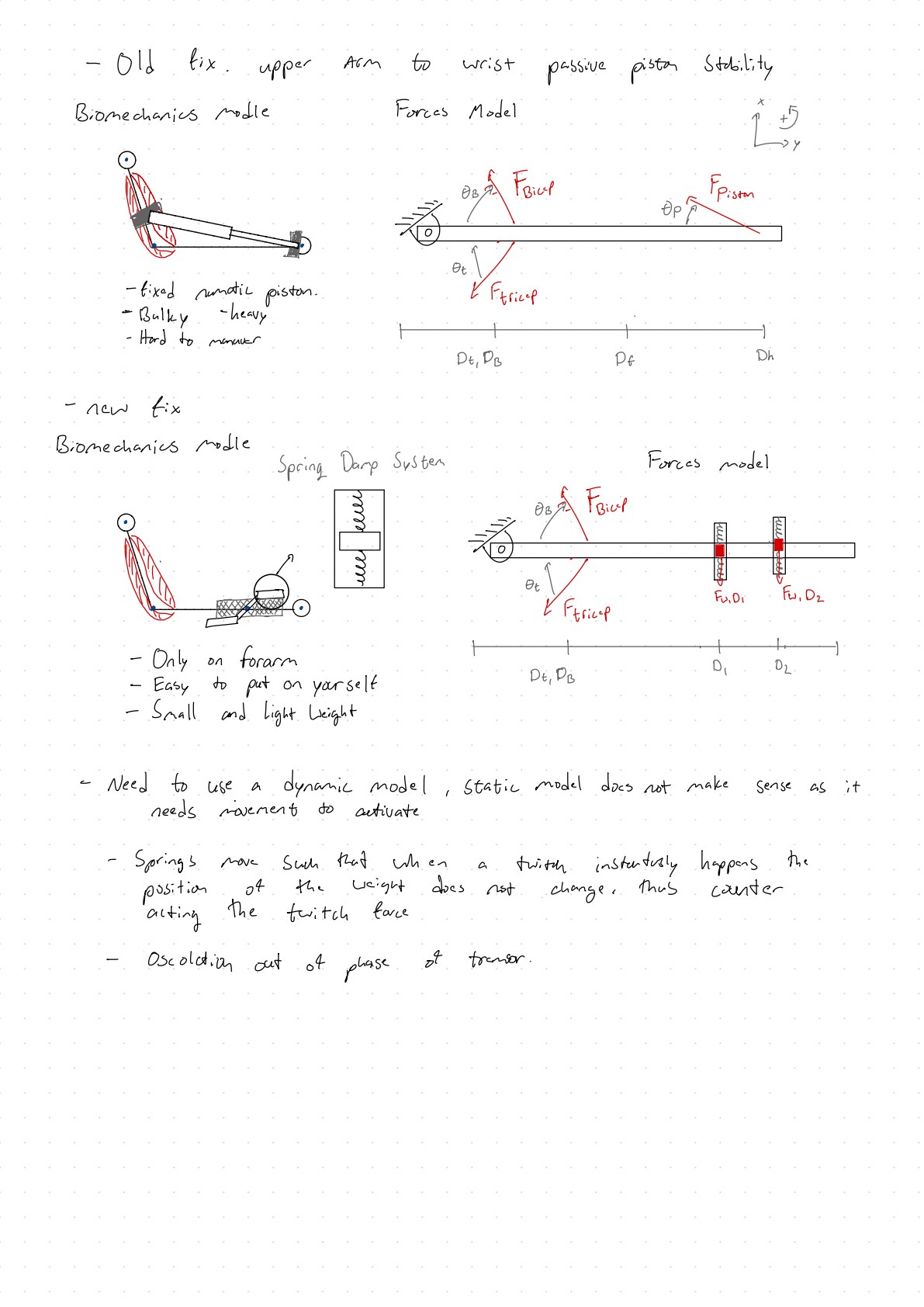
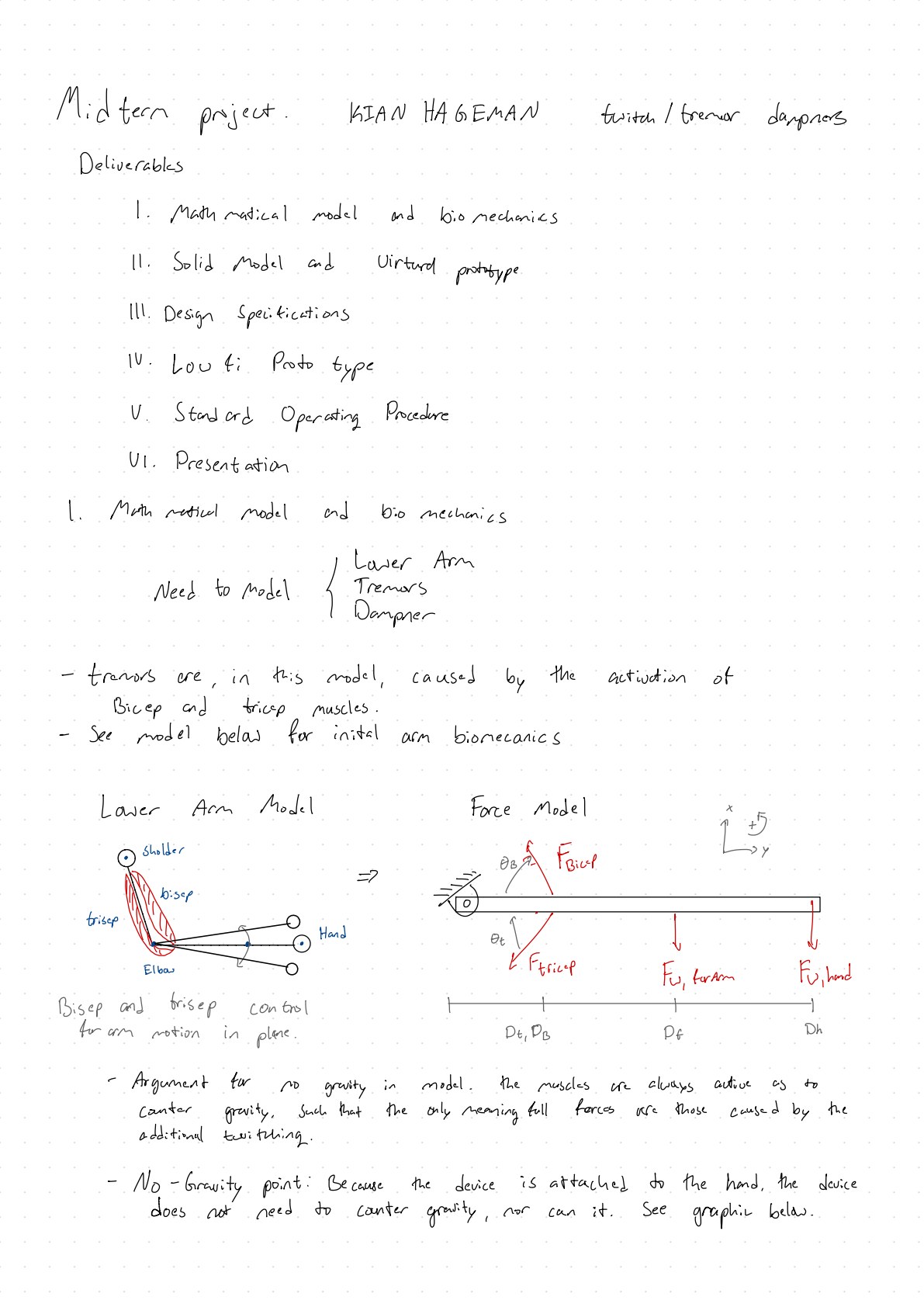
The biomechanical model treats the lower arm as a beam pinned at the elbow, driven by bicep and tricep forces, with the forearm and hand masses distributed along it. Tremor enters the model as involuntary activation of those same two muscles rather than as an external disturbance.

One simplification carries the whole analysis: gravity drops out. The postural muscles are already active and already cancelling gravity, so the only forces left unbalanced are the ones the twitch adds. The device hangs off the arm rather than off the ground, so it cannot counter gravity and does not need to.

Hand-drawn lower arm biomechanical model and force diagram
Lower arm model and force diagram, with the no-gravity argument written out beneath.

Design iteration

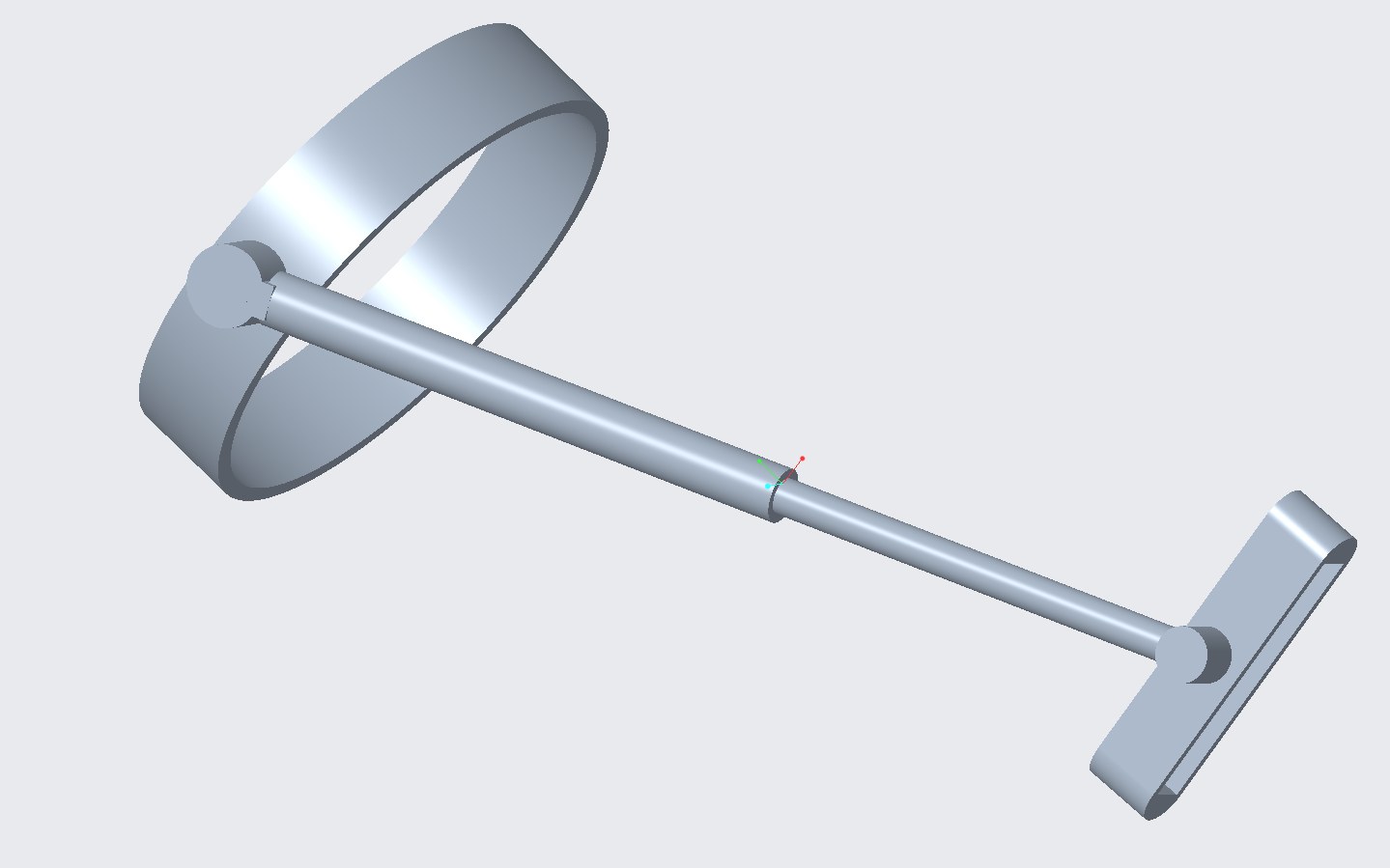
The first concept braced the upper arm to the wrist with a passive piston, adding stability by resisting motion across the elbow. It was modeled in Creo and then discarded: bulky, heavy, awkward to put on alone, and it fought the elbow rather than the tremor.

Creo model of the abandoned upper-arm to wrist piston concept
The abandoned concept: a passive piston spanning the elbow.
Creo model of the piston concept bicep cuff and rail
Bicep cuff and rail from the same concept. Bulky, and it needed a second pair of hands to fit.

The replacement stays entirely on the forearm and stops resisting motion altogether. Instead of bracing the joint, two spring-mounted masses are tuned to oscillate out of phase with the tremor, so the weight stays roughly where it was when a twitch fires and the reaction damps the arm. Small, light, and something a patient can put on without help.

A static model was never going to work for this, since the device only does anything while moving. Everything downstream had to be dynamic.

Hand-drawn comparison of the old piston concept and the new spring-damper concept
Side-by-side of both concepts with their force models, and the reasoning for the switch.

The math

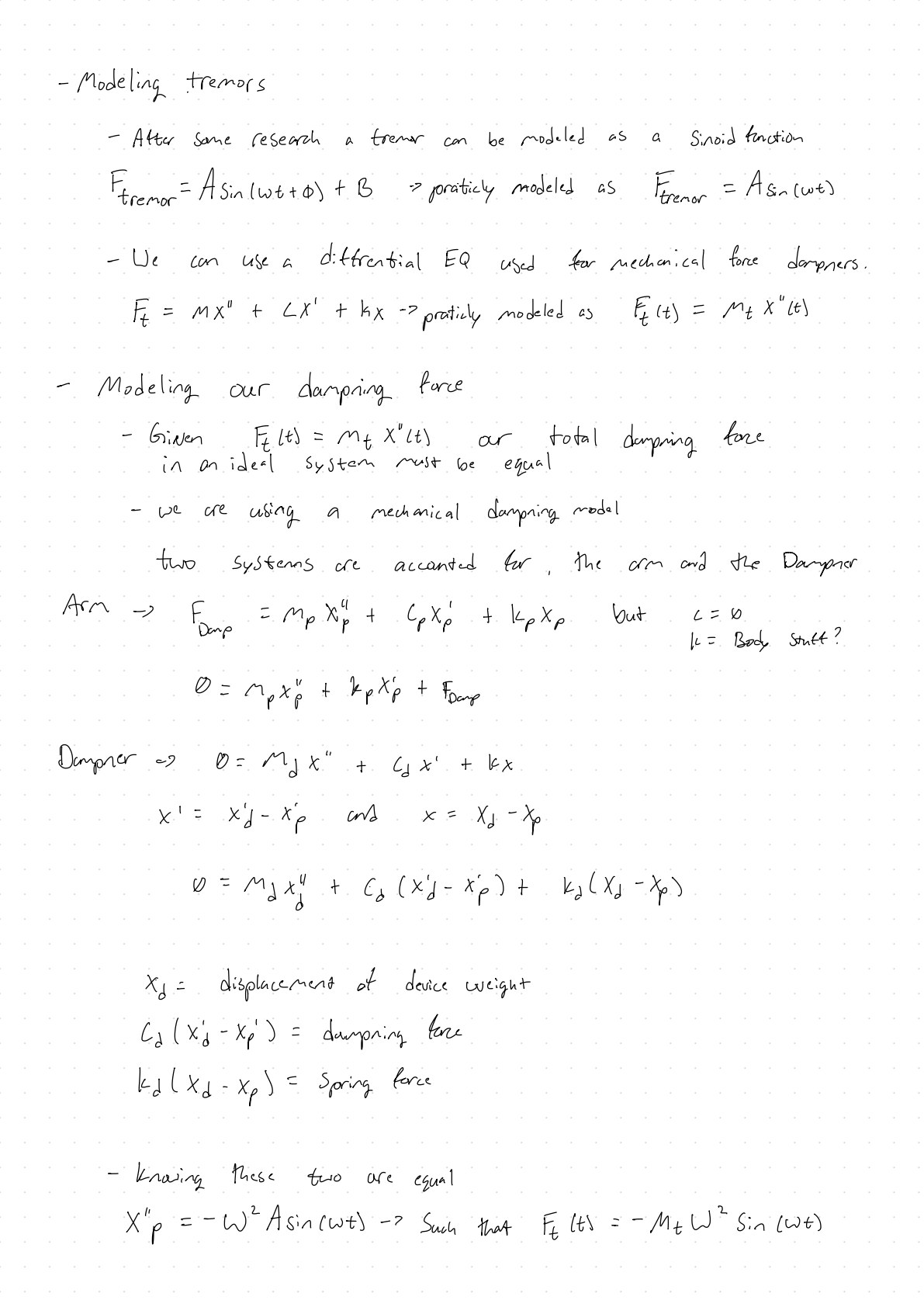
Tremor is modeled as a sinusoid, Ftremor = A sin(ωt), which the literature supports as a working approximation of postural tremor. The damper is a classic tuned mass damper, the same device used to stabilize tall buildings, scaled to a forearm.

Two coupled systems get written out: the arm, carrying the tremor force, and the damper mass riding on its spring and dashpot. The coupling terms are the relative displacement and velocity between them, cd(ẋd − ẋp) for damping and kd(xd − xp) for the spring. Assuming steady-state harmonic motion and substituting complex exponentials reduces the pair to a solvable expression for the damper force.

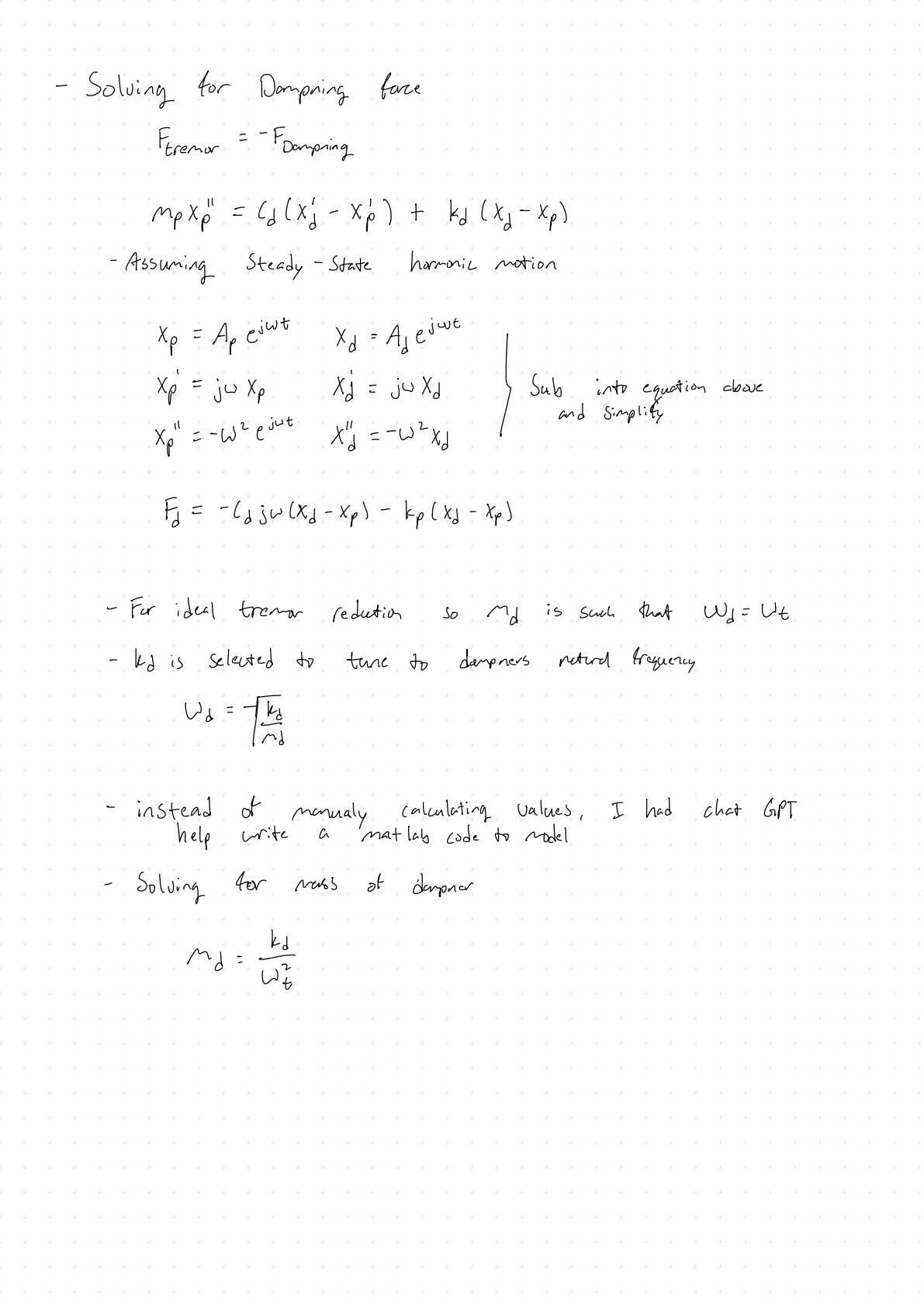
Tuning is the whole game. For maximum suppression the damper’s natural frequency has to match the tremor frequency, ωd = √(kd/md) = ωt, which fixes the mass once the spring rate is chosen. That relationship is what sets the weights in the prototype.

Hand-written derivation of the tremor and damper equations of motion
Tremor as a sinusoid, and the coupled arm and damper equations of motion.
Hand-written solution for the damping force under steady-state harmonic motion
Steady-state harmonic substitution, and the tuning relationship that sizes the damper mass.

Dynamic simulation

Rather than hand-solve for a single tuned frequency, the four-state system was integrated numerically in MATLAB with ode45, tracking hand position, hand velocity, damper position, and damper velocity over a 60-second run.

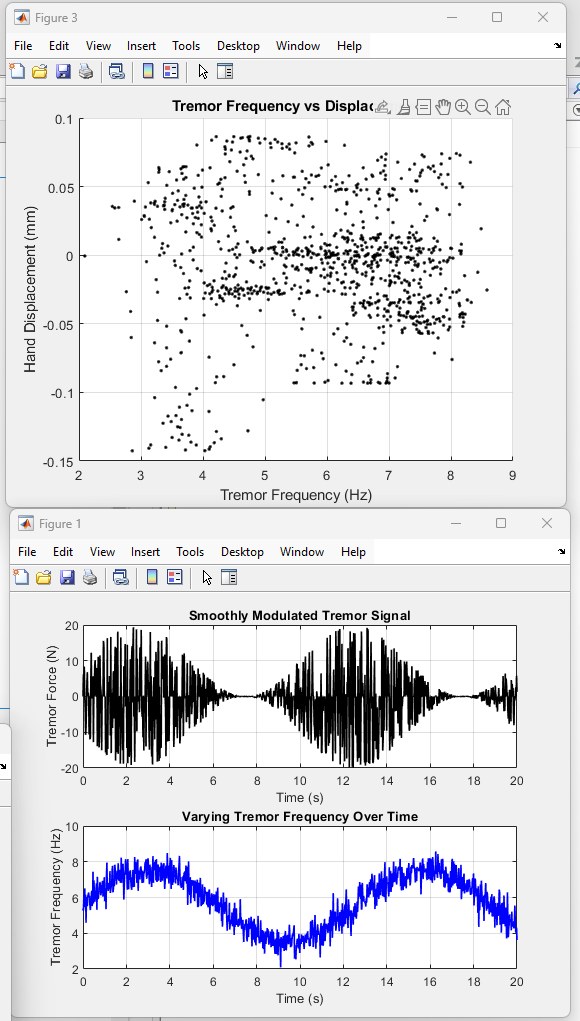
The forcing function is deliberately messy, because real tremor is. It runs at a 5.5 Hz base frequency with a ±2 Hz sinusoidal drift and half a hertz of random noise on top, and the amplitude envelope varies smoothly up to 5 mm with a 30 percent chance of dropping to zero at any moment. That last detail matters: a damper tuned to a perfectly steady sinusoid is an easy problem, and tremor does not behave that way.

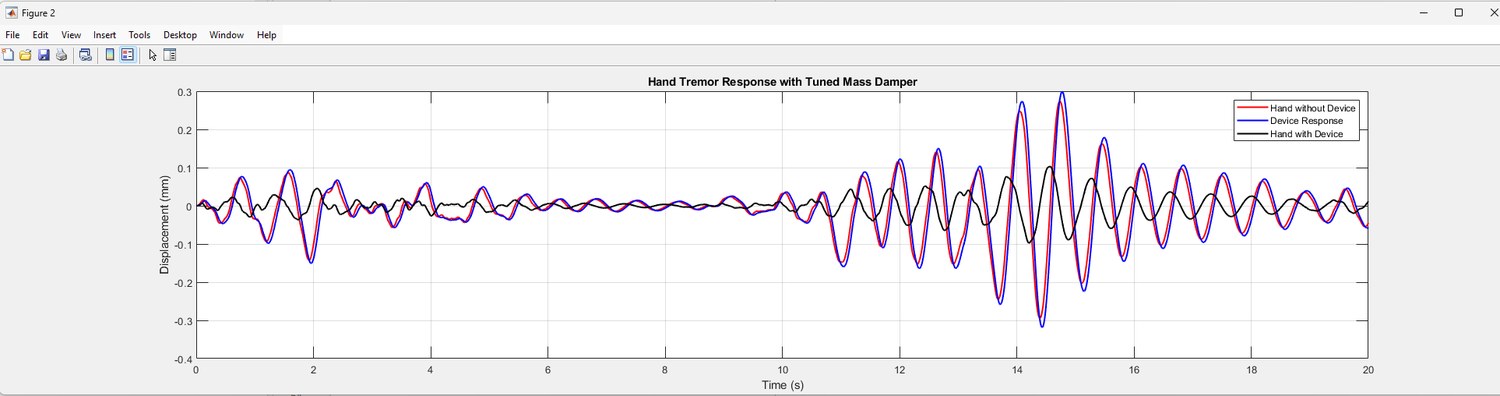
System parameters came from anthropometric data, a 1.2 kg forearm and 0.4 kg hand against a 0.05 kg damper mass at 20 N/m and 5 Ns/m. The output plots hand displacement with and without the device on the same axes, alongside the damper’s own response, so the phase relationship is visible directly.

MATLAB plot of hand tremor response with and without the tuned mass damper
Hand displacement with and without the damper, plotted against the damper\u2019s own out-of-phase response.
MATLAB plots of the modulated tremor signal, varying frequency, and frequency versus displacement
The forcing function: modulated amplitude, drifting frequency, and the resulting displacement spread.

Prototype

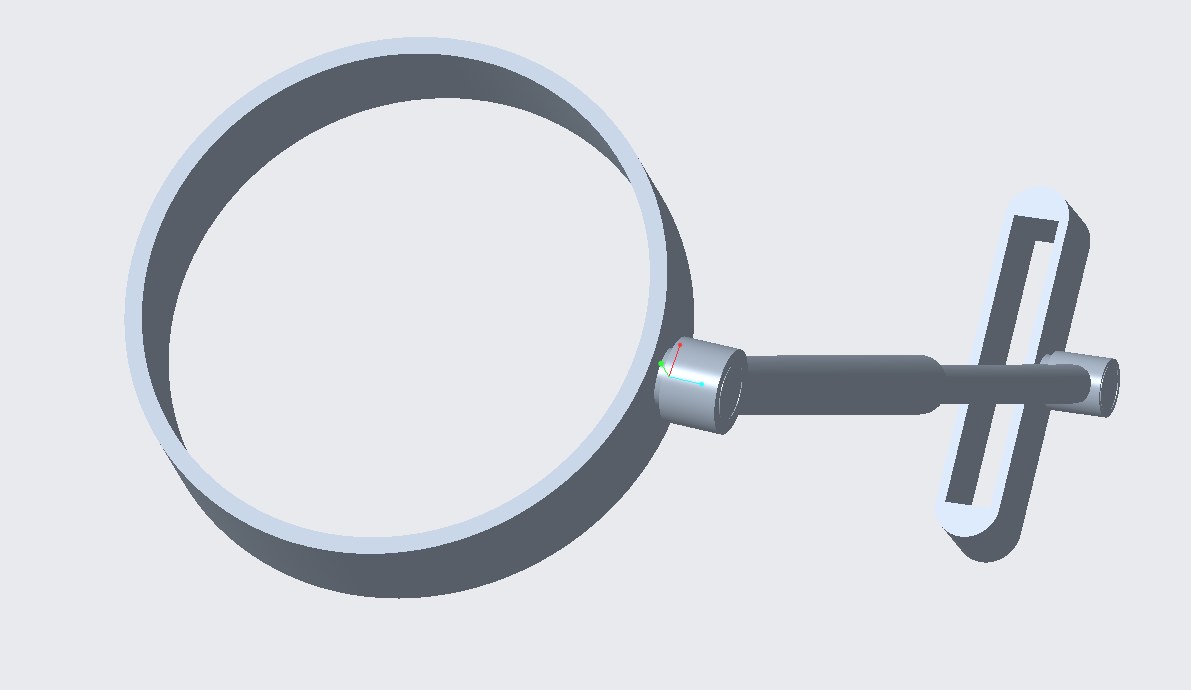
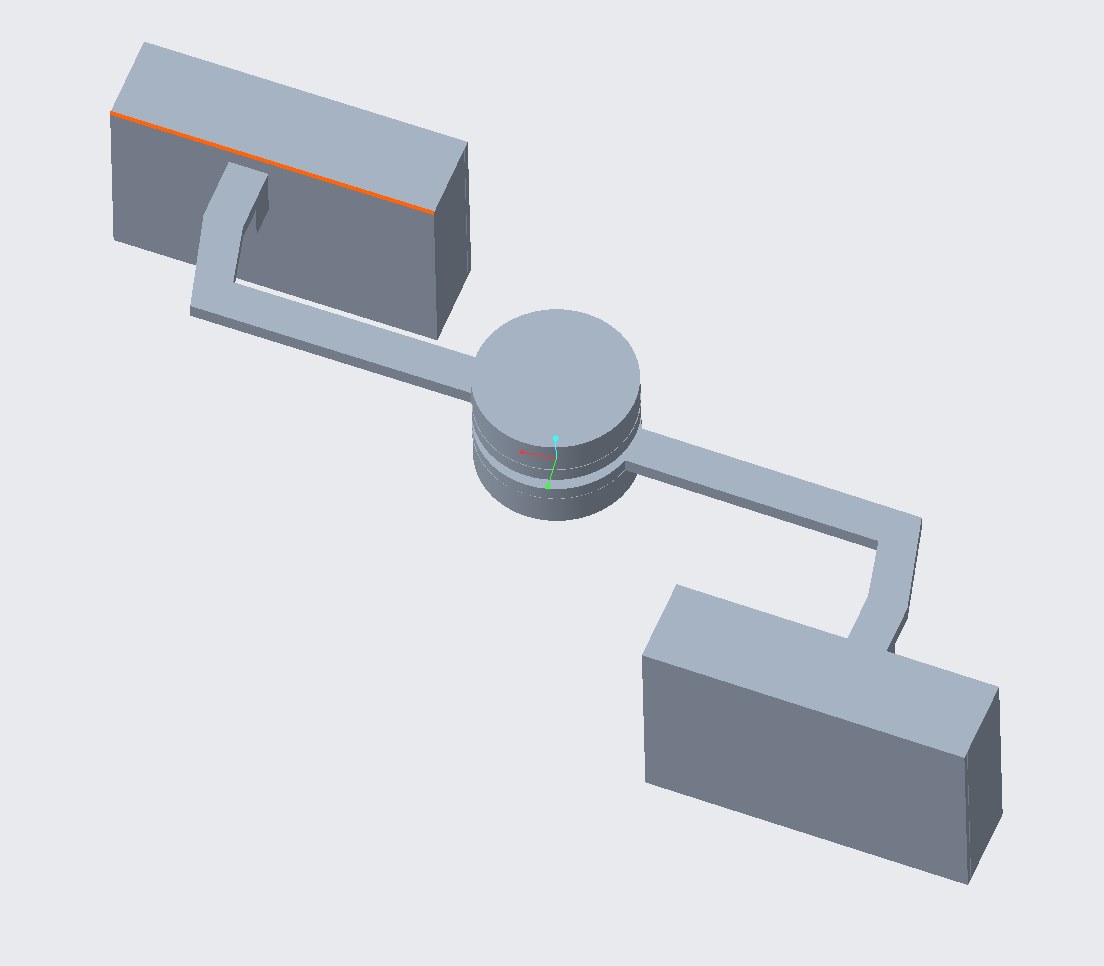
The Creo assembly is the intended build: two damper housings holding sprung lead masses, joined by arms to a circular center support that sits on top of the forearm. Box, spring, and arm dimensions were sized against anthropometric tables using a 77 in frame, giving a 0.95 in spring height inside 1.9 in of travel.

Creo isometric view of the tremor damper assembly
Creo assembly: two damper boxes, arms, and the center support.
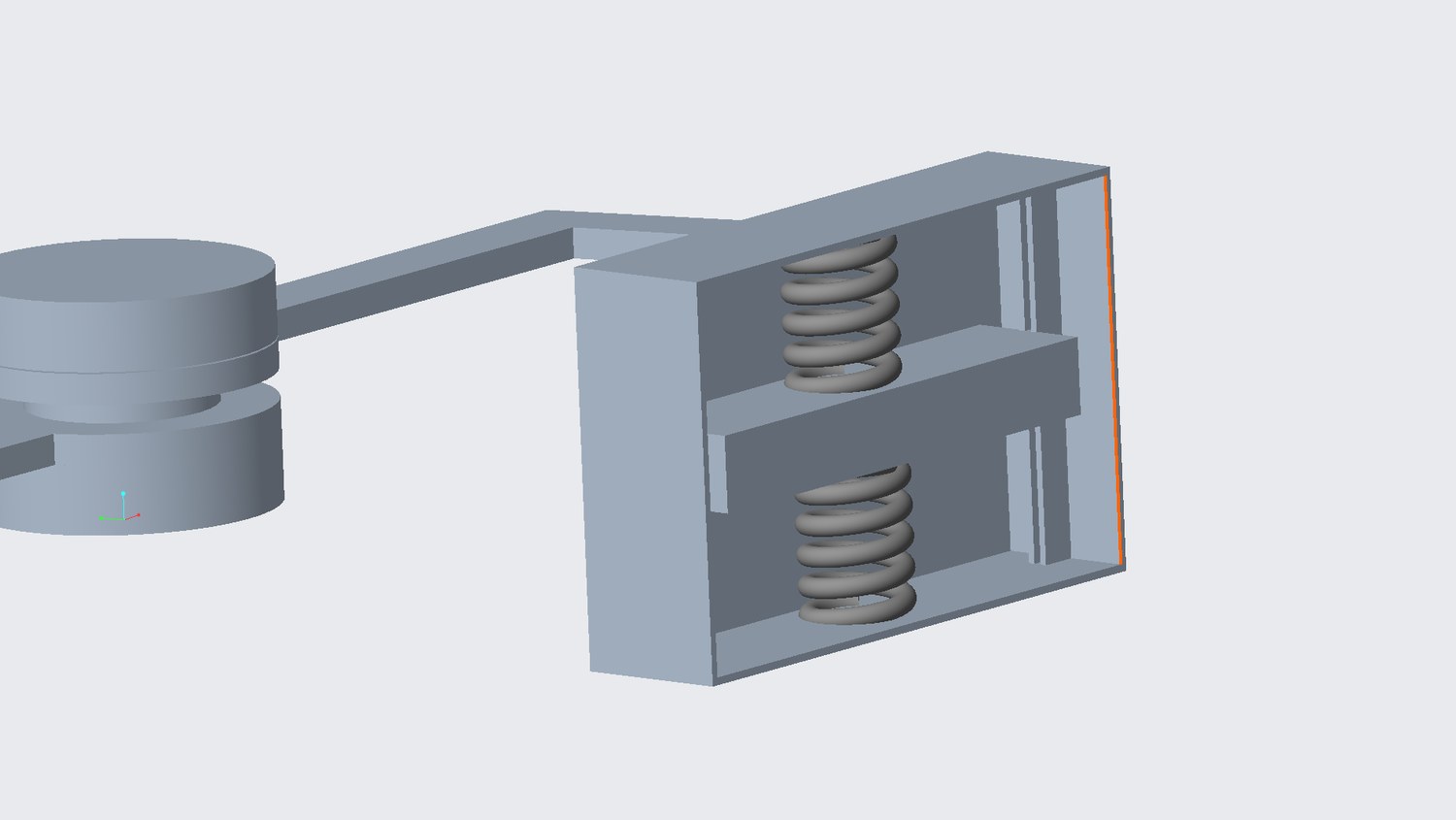
Creo cutaway showing the springs and mass inside a damper housing
Inside a housing. The mass rides between two springs, tuned to the target frequency.

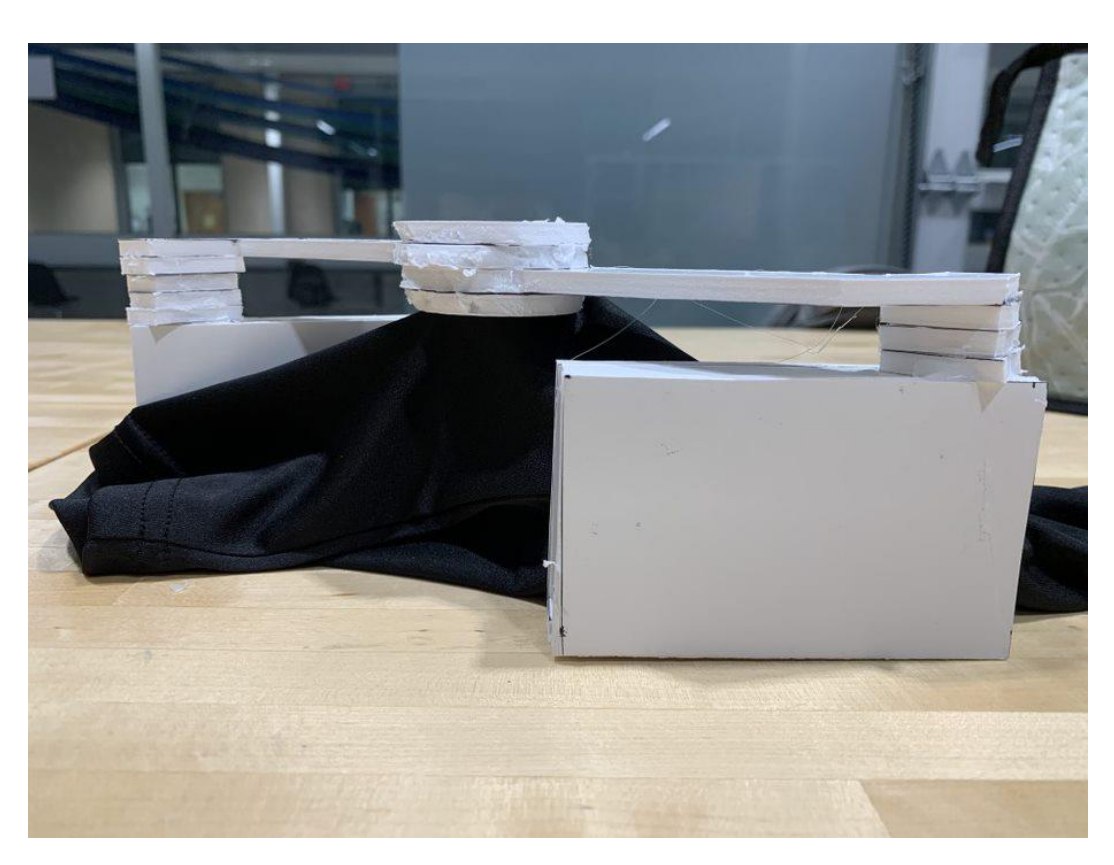
The physical prototype is deliberately low fidelity, built in five hours from 1/8 in foamboard, hot glue, a compression shirt sleeve, and 150 g of split shot. Two sleeves were built, left and right, at 50 g and 25 g per box, so the effect of damper mass could be felt rather than only simulated. The risers are asymmetric, three on one side and four on the other, so the arm assembly sits level once the offset boxes are mounted.

Side view of the foamboard tremor damper prototype showing riser stacks
Side view. Three risers on one side, four on the other, levelling the arm assembly.
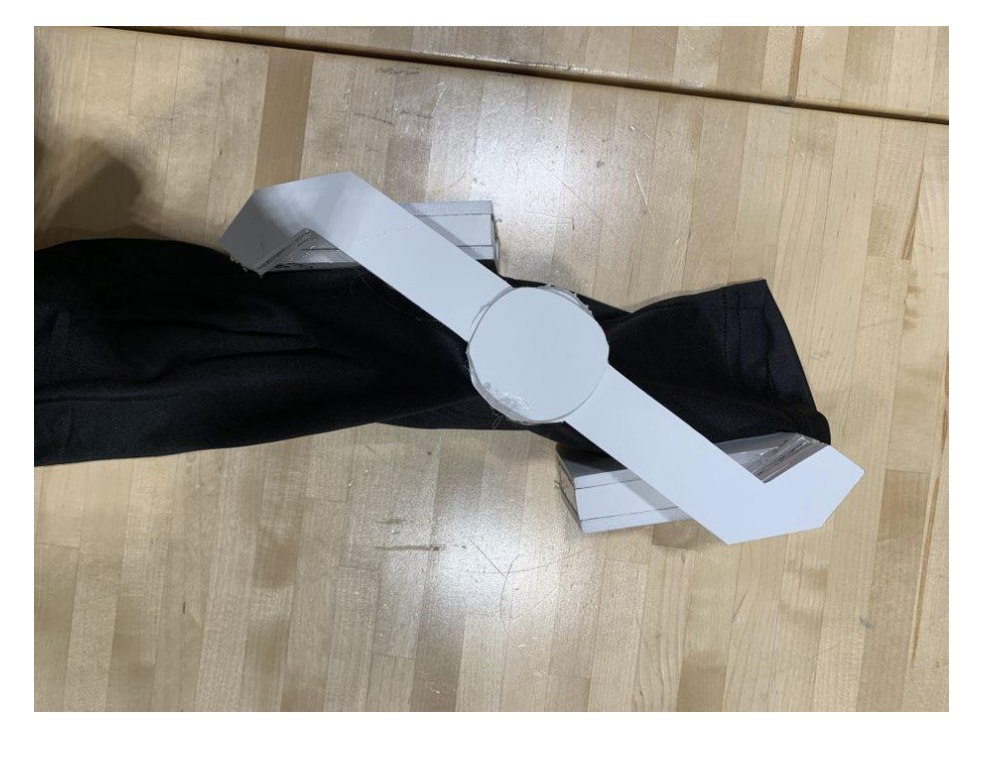
Top view of the prototype mounted on a compression sleeve
Top view, showing the center support and the offset arms.
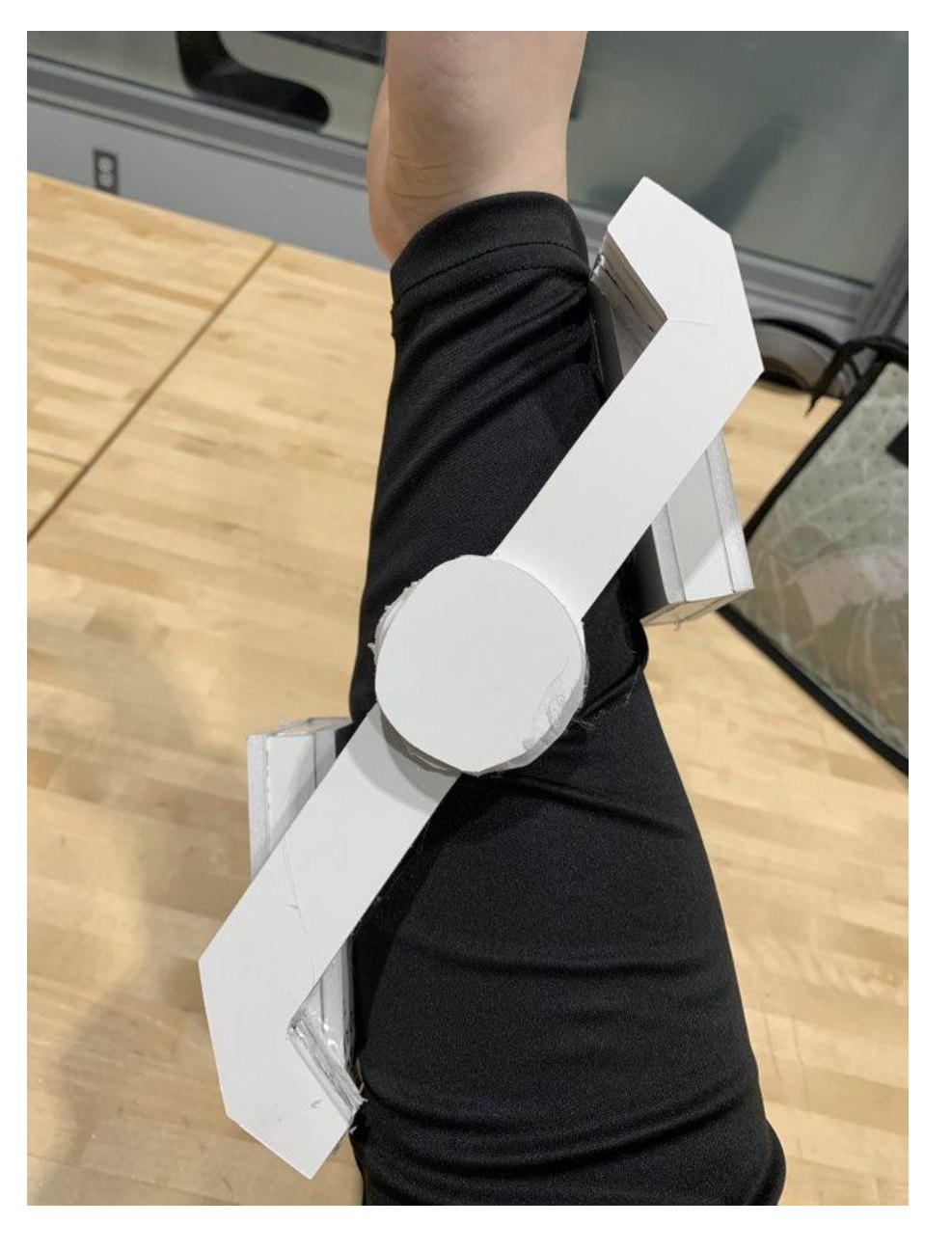
The tremor damper prototype worn on a forearm
Worn. One box outboard near the wrist, one inboard near the elbow.
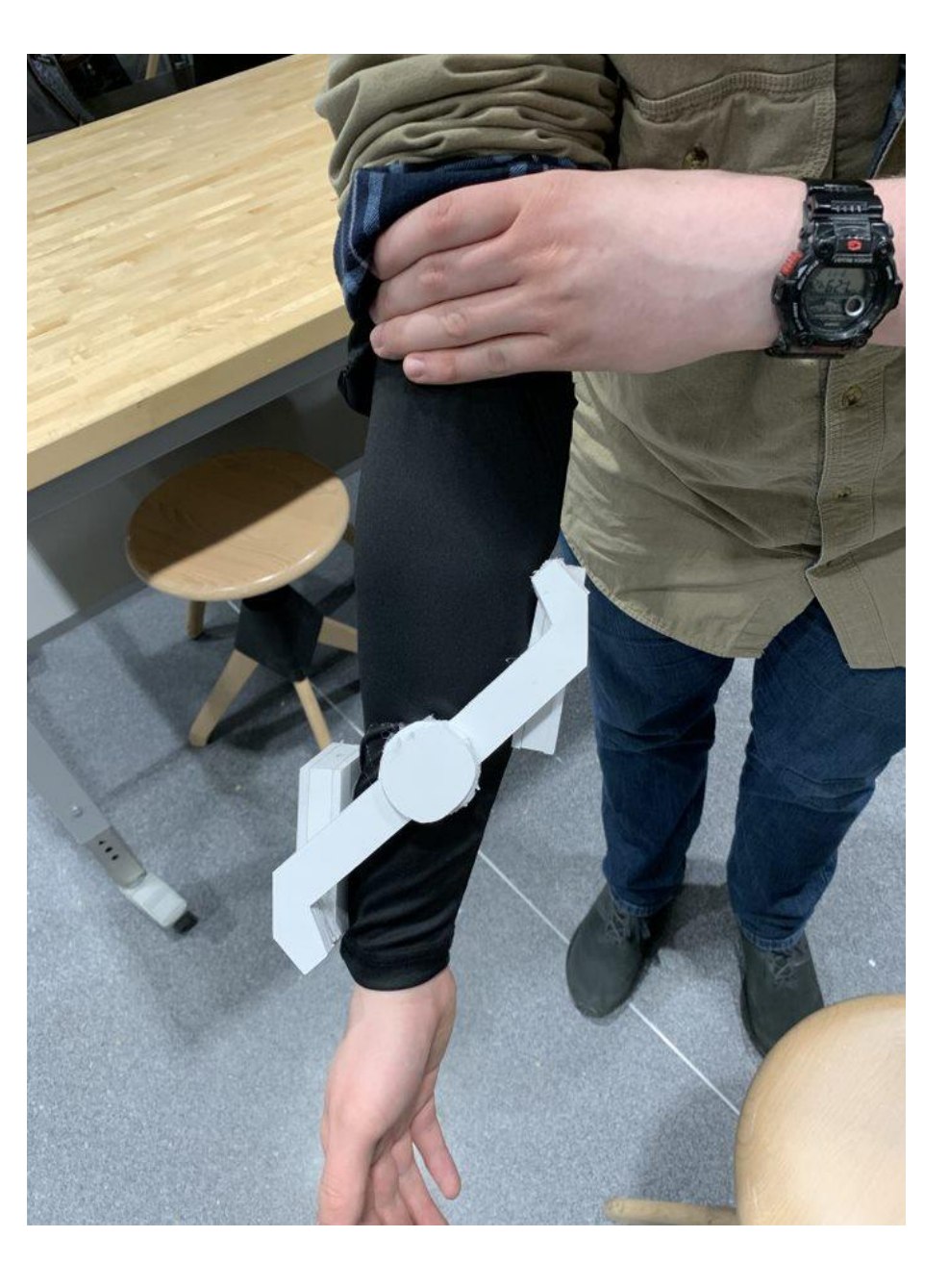
Full view of the prototype sleeve worn on the arm
The full sleeve in place. Total build time, five hours.

Next iteration: metal or plastic housings in place of foamboard, real springs carrying the masses instead of glued-down weights, and an adjustable strap system rather than a cut shirt sleeve.

Keywords

tuned mass damper dynamic modeling MATLAB CAD biomechanics assistive technology prototyping

Deliverables document

Standard operating procedure, bill of materials, the full ten-step build, assembly photographs, and the reference list.

Download PDF

Model work

Biomechanical models, the design iteration, and the complete hand-written derivation of the damper equations.

Download PDF

MATLAB dynamic model

The ode45 tuned-mass-damper simulation, including the modulated tremor generator.

Download .m